IOM
538 Project I
Group
#1, Spring 2002
Content
l
Overview
1.
Definition
2.
CM Benchmark
3.
Industry Growth
4.
Market Size/Share
5.
Financial Analysis
l
Graphical Description
1.
CM Products
2.
Process View
3.
System Interfaces
4.
IT Components
5.
Standards
l
Detailed Comparison Table
l
Abbreviations
l
Useful Links
l
Glossary
Overview
l
Definition
Group
1¡¯s Definition of Content Management
Content
Management (CM) is providing businesses and/or government a single system
strategy via web services and strategic solutions to centralize, facilitate,
enhance, provide competitive advantage, speed process, provide economies
of scale, and help carry out daily Business to Business (B2B)/Business
to Government (B2G)/Business to Consumer (B2C) operations and transactions.
What
do experts say?
¡°Single
system that manages all content for all a business multiple internal
and external websites, portals, and other channel including paper, CD-ROMS,
and wireless applications. Most people are dividing ¡°CM¡± solutions
into two categories: direct-to-web publishing and content management.
Direct-to-web enables business to put content on the web
quickly. They are usually lightweight, not strategic solution.
True Content Management supports enterprise self-service
by enabling the right people to access the right content at any time
and by providing the ability to use that content in appropriate transactions.¡±
-- Broad Vision.
The
following services can be done with Content Management: ¡°develop and
maintain your Web sites with ease, deliver personalized content that
is targeted and relevant to users, leverage industry standards like
Java and XML to integrate with other applications, and scale from departmental
initiatives to enterprise-class applications, while maintaining departmental
control.¡± ¨CDivine.
¡°True
Content Management is the ability to create, personalize, deliver, and
manage content pulled from any part of an extended organization to be
used and re-used in any language for global competitive edge.¡± ¨C Documentum.
¡°FileNET's
solutions are designed for both the enterprise content management and
collaborative commerce markets, enabling organizations to realize increased
productivity, customer satisfaction, and profitability by empowering
customers, business partners, suppliers, and employees to engage in
business processes and exchange relevant content.¡± ¨C FileNet.
¡°Delivers
a Dynamic Web Experience - Relevant, timely and compelling content
are the three success factors for eBusiness, Inclusive Content
Entry - Today's Enterprises need a content management system
that allows collaboration between all Web contributors from throughout
the organization, from the occasional, non-technical contributor to
the Web team itself, and Scalable Infrastructure - Enterprise
class content management accommodates large, dispersed teams of contributors
that work on millions of diverse Web assets. ± ¨C Interwoven.
¡°Content
Management is the ability to manage and deliver content to every electronic
touchpoint.¡±-- Vignette Corporation.
l
CM Benchmark
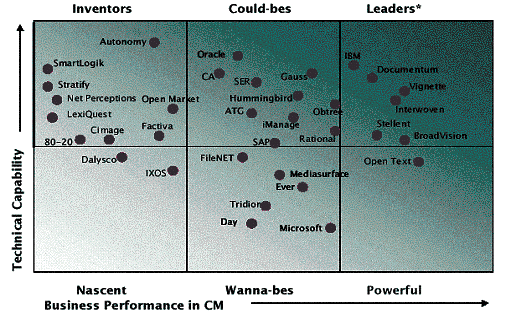
l
Industry Growth
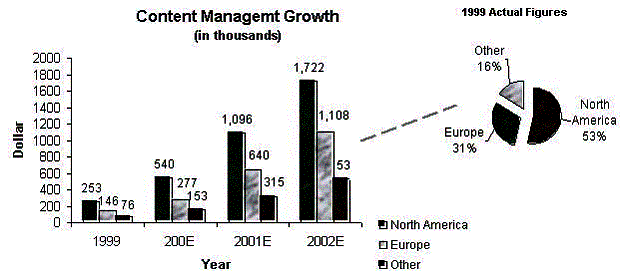
North
America CAGR 1999 - 2002E = 89.51%
Europe CAGR 1999
- 2002E = 96.51%
Other
CAGR 1999 ¨C 2002E = 91.17%
Source: Gaussip¡¯s
Annual Report for 2000 (http://www.gaussip.com)
http://www.magellan.com/Company/Intestors/Gauss-Webb.pdf
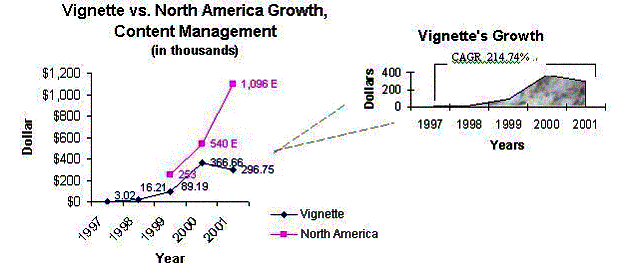
Note:
North America¡¯s 2000 and 2001 values are estimates.
Source:
Vignette Corporation¡¯s Income Statements (http://www.vignette.com),
Gaussip¡¯s Annual
Report for 2000 (http://www.gaussip.com)
http://www.magellan.com/Company/Intestors/Gauss-Webb.pdf
l
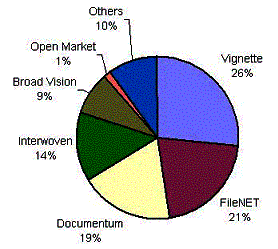
Market Size/Share
Enterprise Content Management Market in 2000
|
Firms
|
Revenues
|
Revenues
from CM1
|
CM Market Share
|
|
|
Vignette
|
366.66
|
70.00%
|
256.66
|
26.80%
|
|
FileNET
|
398.61
|
50.00%
|
199.31
|
20.81%
|
|
Documentum
|
197.59
|
90.00%
|
177.83
|
18.57%
|
|
Interwoven
|
132.13
|
100.00%
|
132.13
|
13.79%
|
|
Broad
Vision
|
413.92
|
20.00%
|
82.78
|
8.64%
|
|
Open
Market
|
88.98
|
15.00%
|
13.35
|
1.39%
|
|
Others2
|
|
|
95.78
|
10.00%
|
|
Market
size3
|
|
|
957.84
|
100.00%
|
| |
|
|
|
Notes:
|
|
|
|
1
|
The
percentage of revenues received from content management software
sales were taken form the Giga Information Group report "Sizing
the Web Content Management Market" 2/22/00
|
|
2
|
We
assumed that the six companies pioneered the content management
market in late 90's kept 90% of the market in 2000 while other
companies accounted for 10% of all sales.
|
|
3
|
The
estimated market size of $957.84 million is close to the estimate
made in the Business Week of
12/11/00, which was $917 million.
|
l
Financial Analysis
2001 Figures
Sector:
Technology Industry: Software &
Technology
|
|
Ratio
|
Broad Vision
|
Documentum
|
FileNet
|
Interwoven
|
Divine
|
Vignette
|
Sector
|
Industry
|
Financial
Strength
|
Quick
Ratio
|
1.64
|
1.75
|
2.63
|
2.93
|
3.78
|
3.39
|
2.46
|
3.10
|
| |
Divine
and Vignette are more successful in converting current assets
quicker into cash. Documentum and Broad Vision are less
effective in converting current assets into cash. FileNet
and Interwoven are under the Industry average, but above the sector
average so they are also successfully able to convert their current
assets quicker into cash.
|
|
Current
Ratio
|
1.72
|
2.07
|
2.82
|
3.01
|
4.17
|
3.43
|
3.01
|
3.43
|
| |
Divine
and Vignette are easily able to meet short-term obligations.
Broad Vision, Documentum, and FileNet may have some difficulty
meeting short-term obligations. Interwoven is able to meet
short-term obligations since they are at the same average as the
sector.
|
|
LT
Debt to Equity
|
0.01
|
0.00
|
0.00
|
0.00
|
.27
|
.05
|
.22
|
.07
|
| |
Divine
has the greatest portion of long-term debt that debt-holders furnish
however the difference from the sector is not much. Documentum,
FileNet, and Interwoven don¡¯t owe any long-term debt to debt-holders.
Broad Vision and Vignette owe very little long-term debt to debt-holder
compared to the industry and sector averages.
|
|
Total
Debt to Equity
|
0.02
|
0.00
|
0.00
|
0.00
|
.31
|
.05
|
.29
|
.08
|
| |
Divine¡¯s
creditors have contributed 31 cents for each dollar of equity
capital, which is slightly more than the sector and much more
than the industry average. Vignette, and Broad Vision don¡¯t
have much capital being provided by creditors. Interwoven, Documentum,
and FileNet don¡¯t have any capital being provided by creditors.
|
Profitability
Ratio
|
|
Net
Profit Margin
|
NM
|
-20.62
|
-5.00
|
-63.72
|
NM
|
-5.14
|
1.63
|
12.87
|
| |
None
of the content management companies had good expense control.
They all experienced revenue losses and did poorly compared to
the sector and industry averages. Interwoven had the poorest
performance. Divine and Broad Vision did not report these
figures.
|
Management
Effectiveness
|
|
Return
on Assets
|
-106.09
|
-18.38
|
-5.33
|
-26.51
|
-86.35
|
-92.77
|
.84
|
6.93
|
| |
None
of these companies made a profit off their assets. Nevertheless
their sector and industry did profit from their assets.
|
|
Return
on Investment
|
-127.98
|
-27.98
|
-7.49
|
-31.84
|
-96.37
|
-102.20
|
2.53
|
9.99
|
| |
All
of these companies have a poor return on investment. FileNet
having the least financial risk, yet still performing poorly compared
to sector and industry averages.
|
|
Return
on Equity
|
-36.91
|
-28.05
|
-7.69
|
-31.84
|
-125.34
|
-102.89
|
4.52
|
10.75
|
| |
None of these companies were able to generate
income of equity investment.
All
companies may have performed poorly in ROA, ROI, and ROE and some
other ratios due to other factors such as Political, Economic,
Social, or Technology factors.
|
|
Microsoft, Computer Associates and IBM
were not included in this comparison due to the difficulty of
separating their content management portion with the rest of the
services they provide. Their figures don't represent the true
market in Content Management.
|
Source:
Ratio figures, http://yahoo.marketguide.com/MGI/mg.asp?target=/stocks/companyinformation/ratio&Ticker=VIGN
Graphical
Description
l
CM Products (Vignette)
Vignette
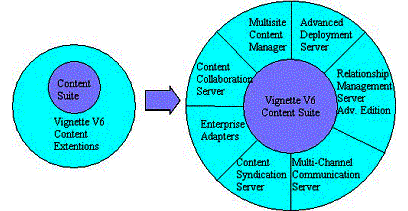
V6 is an open, scalable, reliable and flexible content management solution.
It enables effective online
relationships
with customers, suppliers, partners and employees. The core is V6 Content
Suite, which enables
companies to integrate content
within and across organizational boundaries, manage and deploy content
to
any electronic touch point,
and continually monitor and optimize the effectiveness of its online
channel. And
V6
Content Extensions are extensions to the Vignette V6 Content Suite that
enable advanced capabilities
l
Process View
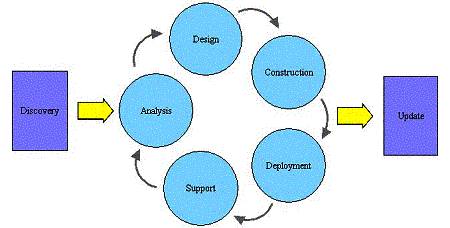
Delivering
the right content to the right person at the right time is accomplished
through proper execution
throughout the content management
lifecycle. In general, a complete content management process contains
seven stages as follows:
Discovery:
Perform initial project scoping and establish objectives, plans;
Analysis:
Define the business and application requirements;
Design:
Design the CM solution and technology infrastructure needed to satisfy
the business requirements;
Construction:
Collect data, create contents following the requirements;
Deployment:
Implement applications based on the requirements and the design;
Support:
System maintenance, project debriefing to gather lessons learned;
Update:
License expires, version updates.
l
System Interfaces
A
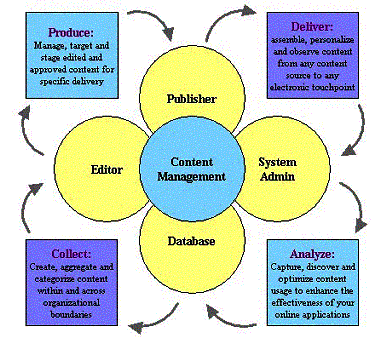
CM system involves various users such as content editors, publishers,
system administrators, and other
systems such as database,
and so on. The following diagram describes such involvement. The corners
represent the interfaces.
Editors can collect data from the database, and then produce the content
based
on the business requirements
and system design; then publishers can deliver the content either as
online
web pages or as offline
CDs, brochures, etc.; then system administrators or other analysis personnel
can
gather the system performance
information, optimize the content, and feedback to the database.
l
IT Components
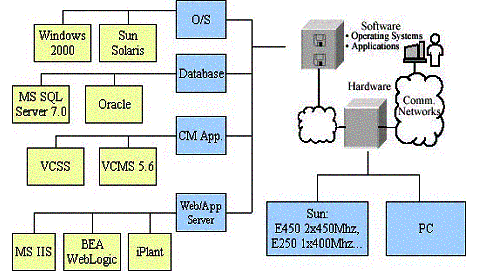
Here, IT components refer
to the hardware and software used in the CM systems.
Hardware: Sun and Windows
PC are mostly selected as DB server, Web server, and Application server;
Software: CM system requires
various software support, including operation system, database, web
server
platform, application server
platform, and CM applications, etc. Examples are given in the diagram.
l
Standards
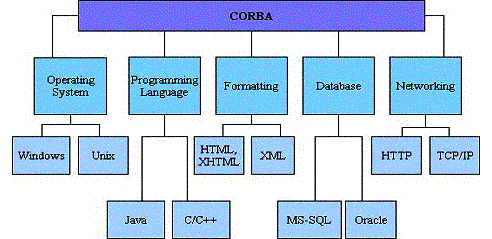
CORBA is an OMG standard
that enables interoperation cross operating system, programming language,
web format, database platform,
and network. CORBA is useful for CM solutions, it can easily integrate
machines from different
vendors. There are also many industry standards such as Java, XML, HTTP
protocols, etc., the details
are described in the following diagram.
Comparison
Table
To view the results
of the comparison table, please click here.
Abbreviations
B2C
Business to Consumer
B2B
Business to Business
B2G
Business to Government
CRM
Customer Relations Management
FTP
File Transfer Protocol
HTTP
Hyper Text Transfer Protocol
TCP
Transport Control Protocol
IP
Internet Protocol
HTML
Hyper Text Mark-up Language
XHTML
eXtensible Hyper Text Markup Language
URL
Uniform Resource Locator
WWW
World Wide Web
XML
eXtensible Markup Language
CORBA
Common Object Request Broker Architecture
OMG
Object Management Group
MS
Microsoft
SQL
Structured Query Language
Useful
Links
Broad
Vision: Content Management company.
http://www.broadvision.com/
FileNet:
Content Management company.
http://www.filenet.com/
Technology
Glossary
http://www.its.bldrdoc.gov/projects/telecomglossary2000
Interwoven:
Content Management company.
http://www.interwoven.com/
Paper
on Content Management by Documentum
http://www.documentum.com/products/collateral/platform/article_ecm_
Paper
on Content Management by Interwoven
http://www.interwoven.com/news/press/2000/0222upsidepr.html
Paper
on Content Management by Broad Vision
http://www.broadvision.com/content/products/whitepaper/contentMgmt_wp.pdf
Vignette
Corporation: Content Management company.
http://www.vignette.com/
Google
Search Engine
http://www.google.com/
Strategy
Partners International
http://www.strategy-partners.com/
Glossary
Applet: A small, self-contained computer
program that usually performs a task as part of, or under the control
of, a larger software application. For example, most modern World Wide
Web browsers are capable of making use of applets written in the Java
programming language to perform simple tasks such as display animations
or more complex tasks such as spreadsheet and database operations.
Source: http://www.vignette.com/
Application: A software
program that carries out some useful task. Database managers,
spreadsheets, communications packages, graphics programs and word processors
are all applications.
Source: Camp, Jeffrey and Stephen Flynn "Internet Data Services: Glossary."
Morgan Stanley Dean Witter August 11, 1999: 175-180.
Browser: A software program
that generally resides on a user's computer and is used to view different
aspects of the Internet.
Source: Camp, Jeffrey and Stephen Flynn "Internet Data Services: Glossary."
Morgan Stanley Dean Witter August 11, 1999: 175-180.
Business to Consumer (B2C): Exchanges
between businesses and consumers; e.g., Amazon.com, Yahoo.com, and Schwab.com.
Source: Rayport, Jeffrey F. and Bernard J. Jaworski. e-Commerce.
New York: McGraw-Hill/Irwin, 2001.
Business to Business (B2B): The full spectrum of e-commerce that can occur between
two organizations, including purchasing and procurement, supplier management,
inventory management, channel management, sales activities, payment
management, and service and support.
Source: Rayport, Jeffrey F. and Bernard J. Jaworski. e-Commerce.
New York: McGraw-Hill/Irwin, 2001.
Channel: 1. A connection between initiating
and terminating nodes of a circuit. 2. A single path provided by a transmission
medium via either (a) physical separation, such as by multi pair cable
or (b) electrical separation, such as by frequency- or time-division
multiplexing. 3. A path for conveying electrical or electromagnetic
signals, usually distinguished from other parallel paths. 4. Used in
conjunction with a predetermined letter, number, or codeword to reference
a specific radio frequency. 5. The portion of a storage medium, such
as a track or a band, that is accessible to a given reading or writing
station or head. 6. In a communications system, the part that connects
a data source to a data sink. 7. A virtual area where Internet Relay
Chat (IRC) users communicate (exchanging text messages) in real time.
Note: There are thousands of channels located on the Internet. 8. An
IRC conduit designated for the real-time exchange of text messages.
9. An electrical path suitable for the transmission of communications
between two or more points, ordinarily between two or more stations
or between channel terminations in Telecommunication Company central
offices. A channel may be furnished by wire, fiber optics, radio or
a combination thereof. 10. The portion of the electromagnetic spectrum
assigned by the FCC for one emission. In certain circumstances, however,
more than one emission may be transmitted on a channel.
Source: http://www.itsbldrdoc.gov/projects/telecomglossary2000/
Content Analysis: The ability to provide
actionable insight into the customer's relationship to a business.
Source: http://www.vignette.com/
Content Integration:
The ability to integrate a variety of e-business applications within
and across enterprises.
Source:
http://www.vignette.com/
Content Management: The
ability to provide actionable insight into the customer's relationship
to a business.
Source:
http://www.vignette.com/
Customer
Relations Management (CRM): a business strategy
intended to help companies acquire, retain, and service customers.
Source: Schneiderman, Nathan and
Adrienne Yih. "The Emerging Face of Customer Relationship Management."
Wedbush Morgan Securities Industry Report/September 2001.
Electronic-business (e-business): Any process that a business organization conducts
over a computer-mediated network. Business organizations include
any for-profit, governmental, or nonprofit entity. Their processes
include production, customer, and internal or management focused business
processes.
Source: http://www.ecommerce.gov/ecomnews/e-def/html
Electronic-mail (e-mail): Messages sent and received electronically via telecommunication links,
such as between microcomputers or terminals.
Source: Rayport, Jeffrey F. and Bernard J. Jaworski. e-Commerce.
New York: McGraw-Hill/Irwin, 2001.
Electronic-market (e-market): Web sites where buyers and sellers come together
to communicate, share ideas, advertise, bid in auctions, conduct transactions,
and coordinate inventory and fulfillment. e-markets may be structured
"horizontally" to serve more generic economic functions for a wide array
of industries. Alternatively, they may be structured "vertically"
in the sense that they are channeled to serve specific industries (e.g.,
computing, life sciences, paper, chemical, and steel). e-markets
may sometimes be referred to as liquid markets or trading exchanges.
Source: Sood, Rakesh, et al. "E-Commerce/Internet: B2B:2B or Not 2B?"
Goldman Sachs Investment Research 12 Nov. 1999: 188-189.
Electronic-commerce (e-commerce): Transaction completed over a computer- mediated network
that involves the transfer of ownership or rights to use goods or services.
Transactions occur within selected e-business processes (e.g., selling
process) and are "completed" when agreement is reached between the buyer
and seller to transfer the ownership or rights to use goods or services.
Completed transactions may have a zero price (e.g., a free software
download).
Source: http://www.ecommerce.gov/ecomnews/e-def/html
File Transfer Protocol (FTP): A method for downloading and uploading files to
and from an Internet site.
Source: Camp, Jeffrey and Stephen Flynn "Internet Data Services: Glossary."
Morgan Stanley Dean Witter August 11, 1999: 175-180.
Hardware: 1.Physical equipment as opposed
to programs, procedures, rules and associated documentation. 2.The generic
term dealing with physical items as distinguished from its capability
or function such as equipment, tools, implements, instruments, devices,
sets, fittings, trimmings, assemblies, subassemblies, components, and
parts. The term is often used in regard to the stage of development,
as in the passage of a device or component from the design stage into
the hardware stage as the finished object. 3.In data automation, the
physical equipment or devices forming a computer and peripheral components.
Source: http://www.itsbldrdoc.gov/projects/telecomglossary2000/
Hyper Text Transfer Protocol (HTTP): A protocol that allows HTML documents to be moved across the
Internet.
Source: Camp, Jeffrey and Stephen Flynn "Internet Data Services: Glossary."
Morgan Stanley Dean Witter August 11, 1999: 175-180.
Hyper Text Mark-up Language (HTML): A formatting language used to create pages on the WWW. A major
feature allows documents to link to any other documents on the Web.
Documents can be viewed through a browser that runs on your computer.
Source: http://www.itsbldrdoc.gov/projects/telecomglossary2000/
Internet: A web of hundreds
of thousands of computer networks, linked together primarily by telephone
lines through which data can be carried around the world in seconds.
Source: Rayport, Jeffrey F. and Bernard J. Jaworski. e-Commerce.
New York: McGraw-Hill/Irwin, 2001.
Intranet: Any private
network that uses some or all of the protocols of The Internet. Note:
In an intranet, nodes interact in a client-server relationship, nodes
are identified by using Internet protocol (IP) addresses, and files
are identified by universal resource locators (URLs). The data being
exchanged are typically formatted using the HTML language, and is controlled
and displayed using a browser. The intranet may be connected to The
Internet via firewalls, or it may be totally separate.
Source: http://www.itsbldrdoc.gov/projects/telecomglossary2000/
Network: 1.An interconnection of three
or more communicating entities. 2.An interconnection of usually passive
electronic components that performs a specific function (which is usually
limited in scope), e.g., to simulate a transmission line or to perform
a mathematical function such as integration or differentiation. Note:
A network may be part of a larger circuit.
Source: http://www.itsbldrdoc.gov/projects/telecomglossary2000/
On-line: 1.Pertaining to the operation
of a functional unit when under the direct control of the system with
which it is associated. Note 1: On-line units are available for immediate
use on demand by the system without human intervention. Note 2: On-line
units may not be independently operated. 2.Pertaining to equipment that
is connected to a system, and is in operation. 3.In computer technology,
the state or condition of a device or equipment that is under the direct
control of another device. 4.In computer technology, the status of a
device that is functional and ready for service. Also spelled "on line"
and "online."
Source: http://www.itsbldrdoc.gov/projects/telecomglossary2000/
Platform: 1.The type of computer on which
a given operating system or application runs. Synonym hardware platform.
2.The operating system in use on a given computer. Synonym operating
system platform. 3.The application program in use on a given computer
and operating system. Synonym application platform. Note 1: The term
platform, usually with some kind of accompanying qualifying verbiage,
may also be applied to any combination of the foregoing. Note 2: The
term cross-platform may be used to characterize an application program
or operating system that may be run on more than one platform.
Source: http://www.itsbldrdoc.gov/projects/telecomglossary2000/
Port: A specific gateway
into and/or out of a computer system. This term can apply to physical
plugs, such as a printer or modem port. On the Internet, it specifically
applies to programmed gateways that lead to specific features within
computer systems.
Source: Camp, Jeffrey and Stephen Flynn "Internet Data Services: Glossary."
Morgan Stanley Dean Witter August 11, 1999: 175-180.
Server: A computer or
software program that controls the dissemination and movement of information.
Source: Camp, Jeffrey and Stephen Flynn "Internet Data Services: Glossary."
Morgan Stanley Dean Witter August 11, 1999: 175-180.
Software: 1.A set of computer programs,
procedures, and associated documentation concerned with the operation
of a data processing system; e.g., compilers, library routines, manuals,
and circuit diagrams. 2.Information (generally copyrightable) that may
provide instructions for computers; data for documentation; and voice,
video, and music for entertainment or education.
Source: http://www.itsbldrdoc.gov/projects/telecomglossary2000/
Uniform Resource Locator (URL): Specifies a transmission protocol and an Internet
identifying number.
Source: Rayport, Jeffrey F. and Bernard J. Jaworski. e-Commerce.
New York: McGraw-Hill/Irwin, 2001.
Wireless: Descriptive
of a network or terminal that uses electromagnetic waves (including
rf, infrared, laser, visible light¨Cand acoustic energy) rather than
wire conductors for telecommunications.
Source:
http://www.itsbldrdoc.gov/projects/telecomglossary2000/
World Wide Web (WWW): A subset of the
Internet that is accessible through the use of HTTP to link documents
at various URLs that are composed in HTML.
Source: Rayport, Jeffrey F. and Bernard J. Jaworski. e-Commerce.
New York: McGraw-Hill/Irwin, 2001.
eXtensible Markup Language (XML):
A trimmed specification or version of the Standard Generalized Markup
Language (SGML) that allows Web developers to create customized tags
for additional functionality.
Source:
http://www.itsbldrdoc.gov/projects/telecomglossary2000/
|