|
1.1
Market Definition- The advent of the Internet and the associated
explosive growth in databases has thrust Business Intelligence (BI)
into the forefront of many corporate technology initiatives. This has
created enormous opportunities for companies offering BI services.
A small fraction of BI companies act only as software vendors, while
the majority of BI firms offer their customers and business partners
a comprehensive set of BI solutions and services including various degrees
of account management, consulting, education and technical support.
Product
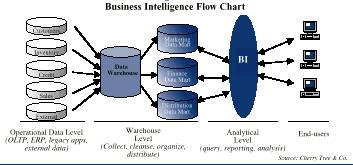
Definition- BI products and applications are decision support tools
that enable real-time, interactive access, analysis and manipulation
of mission-critical corporate information. These applications provide
users with valuable insight into key operating information to quickly
identify business problems and opportunities[1]. BI products incorporate a wide
range of available corporate information resources including data warehouses,
data marts, transaction processing applications and strategic applications
(CRM, ERP, etc.).
1.2
Market Size/Relative Size- AMR Research found that companies are
investing more than $1.5 billion per quarter on BI related applications[2].
Internet technologies have renewed interest in BI tools. Market size
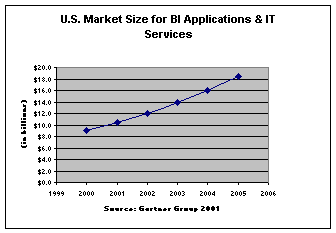
for BI applications and services totaled $9.1 billion in 2000 and approximately
$10.4 billion in 2001. To put this into perspective, the semiconductor
industry had U.S. sales of $62 billion in 2000 and approximately $77
billion in 2001[3].
1.3 Growth/CAGR-
Anticipated growth rates of the BI industry vary depending on the source.
Some estimate a CAGR of 40% through 2005[4], while others are
less optimistic. A majority of sources, however, expects the industry
to have a CAGR between 15-16%. The Gartner Group projects the BI industry
to grow to $12 billion in 2002, $13.8 billion in 2003, $16 billion in
2004, and $18.5 billion in 2005. This represents a CAGR of 15.4%[5].
Technology Description:
2.1 System Design:
Inputs –> Process –> Outputs.
Microstrategy provides
a Business Intelligence solution designed to enable businesses to gain
new insight from the multiple interrelationships inherent in their data,
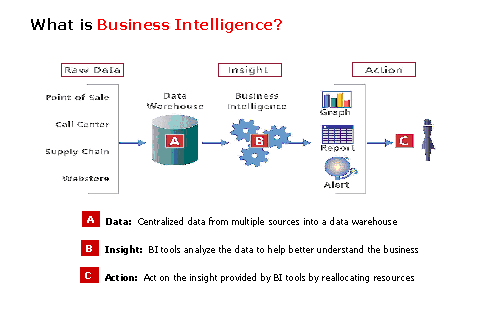
but not readily visible. OLTP systems provide for input of raw data
into the data systems in a real time processing function. The intelligence
layer provides an on-line analytical processing function designed to
cross reference dimensions, providing a data mining capability. The
data can then be compared and analyzed to provide calculations, statistics
and reporting figures for analysis. The end goal being, qualified decision-making
processes supported by timely credible information.
2.2 Key Components
- OLAP providers, Enterprise Data Warehouses, and Data Marts each
provide raw data, which the Microstrategy business intelligence layer
manipulates using advanced algorithms to gain new insights[6].
Analysis is conducted and forwarded via flexible reporting formats to
decision makers for review. The suite’s functionality is exposed
via the API enabling user interface customization, development of web
applications and integration with administration and security systems.
2.3 Critical
system interfaces:
Data origination
for the actual business intelligence process is typically the data warehouses
(Enterprise or Data Mart), which are updated via the OLTP application
system. Microstrategy employs a decision support system with
a data warehouse, intelligence server, and Microstrategy agent in a
three-tier system. It is Microstrategy’s proprietary intelligence
server, which provides powerful analytics, scalability, extensibility,
and security[7].
3. Detailed
Product/Vendor Comparison Table
| |
Flexibility
|
Compatibility
|
Ease
of Use
|
Cost
|
Installations
& Deployment
|
Manual
& Tutorials
|
Security
|
Brio
Enterprise 6.2.2
|
∙∙∙∙
|
∙∙∙
|
∙∙∙
|
∙∙∙
|
∙∙∙
|
∙∙∙
|
∙∙∙
|
|
Cognos
Business Intelligence Platform
|
∙∙∙
|
∙∙∙∙
|
∙∙
|
∙∙∙
|
∙∙
|
∙∙
|
∙∙∙
|
|
Crystal
Enterprise 8.0
|
∙∙∙∙
|
∙∙∙
|
∙∙
|
∙∙∙
|
∙∙∙
|
∙∙∙∙
|
∙∙∙∙
|
|
MicroStrategy
7
|
∙∙∙∙
|
∙∙∙
|
∙∙∙∙
|
∙∙∙
|
∙∙∙∙
|
∙∙∙∙
|
∙∙∙
|
This table shows
the results of a comparison study on four Business Intelligence software
developed by different companies, namely Microstrategy Inc., Cognos
Inc., Crystal Decisions Inc., and Brio Technology. The criteria are
rated on a scale of 1-5, with 5 being the best. There are a total
of seven measures, which include cost, installation, manuals and tutorials,
flexibility, compatibility, ease of use, and security. The measures
are weighted in the following order of importance:
Flexibility:
The ability of the software to change and provide different creative
reporting functions. In our analysis MicroStrategy offers great flexibility
and it is one of its core strengths. You can alter and manipulate tables
on the fly along with many other features for reporting.
Compatibility:
The ability of the software to merge with the existing system and
software.
Ease of use:
The friendliness of the software for users to learn and to operate.
Other factors include, process time, set-up of the interface etc. MicroStrategy
provides a friendly user interface and functionality that users of different
experience levels can use.
Cost: The
price of the complete software package. It does not include peripherals
such as updates or long-term technical support. For Microstrategy 7,
Prices begin at $30,000 per server CPU and
$15,000 per Web server CPU.
Installation
& Deployment: The time and effort to fully implement and distribute
the software into a business.
Manuals and
tutorials: The quality and the quantity of support that came with
the software. For example, Crystal Enterprise 8.0 comes with a detailed
manual that is far easier to understand than the documentation offered
by competitors.
Security: The
ability of the software to keep out intruders.
4.
List of Abbreviations and Explanations
Business Intelligence
(BI)- is a broad category of applications and technologies for gathering,
storing, analyzing, and providing access to data to help enterprise
users make better business decisions. BI applications include the activities
of decision support systems, query and reporting, online analytical
processing (OLAP), statistical analysis, forecasting, and data mining.
Central Processing
Unit (CPU)- is the control unit that processes
all of the instructions for the computer. It is considered the
"brain" of the computer.
Customer
Relationship Management (CRM)- an information industry term for methodologies,
software, and usually Internet capabilities that help an enterprise
manage customer relationships in an organized way.
Data Warehouse-
a central repository for all or significant parts of the data that an
enterprise's various business systems collect.
Data Mart- a
repository of data gathered from operational data and other sources
that is designed to serve a particular community of knowledge workers.
Data Mining- is
a set of techniques used in an automated approach to exhaustively explore
and bring to the surface complex relationships in very large datasets.
Decision Support
System (DSS)- is a computer program application that analyzes business
data and presents it so that users can make business decisions more
easily.
Enterprise Resource
Planning (ERP)- an industry term for the broad set of activities supported
by multi-module application software that help a manufacturer or other
business manage the all the parts of its business.
Online Analytical
Processing (OLAP)- a category of software tools that provides analysis
of data stored in a database. OLAP tools enable users to analyze different
dimensions of multidimensional data. For example, it provides time series
and trend analysis views.
Online
Transaction Processing (OLTP)- a class of program that facilitates and
manages transaction-oriented applications, typically for data entry
and retrieval transactions in a number of industries, including banking,
airlines, mail-order, supermarkets, and manufacturers.
Structured
Query Language (SQL)- a computer language that talk to the database
to retrieve specialized requests.
Web
Server- is a program that, using the client/server model and the World
Wide Web's Hypertext Transfer Protocol (HTTP), serves the files that
form Web pages to Web users (whose computers contain HTTP clients that
forward their requests).
5.
Useful Web Links
www.pcmag.com/article2
www.informationweek.com
www.microstrategy.com
www.cognos.com
www.crystaldecisions.com
www.brio.com
www.amrresearch.com
www.cherrytreeco.com
www.gartner.com
www.datamonitor.com
|