Supply
Chain Management Systems
IOM
538 Information Systems Strategy
Professor
C. Schlueter-Langdon
©
2002 Eric Frisco, George
McKinney, Danny Pradhana, Myron Sztonyk, Michelle Tsai
Industry
Overview
Market Size and Growth
Electronic business
is forcing more companies to scrutinize their supply and distribution
channels, looking for new ways to deliver products faster, more accurately
and efficiently. The trend is generating a flurry of activity in the
market for supply-chain management applications, which are used to coordinate
the flow of material between businesses and their suppliers and distributors.
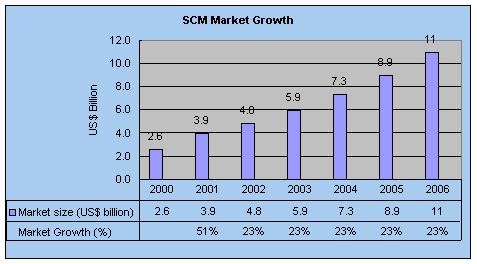
In 2001, the $3.9 billion market is poised to quadruple over the next
five years, according to AMR Research Inc. [1]
There is ample
room for SCM market growth. Although only about a quarter of manufacturers
have already installed SCM software, a large 14% expect to implement
some sort of SCM application. The surge will be led by pharmaceutical
manufacturers, representing 43% of their industry (source: AMR
Research survey in June 2000).
The market will grow at a 20% compound annual growth rate (CAGR) to
more than $11 billion by 2006, according to a study by ARC in November, 2001.
[2] Based on the forecasted CAGR from ARC, the SCM market
growth is estimated and graphed as below.
Market Segmentation
According to Venture
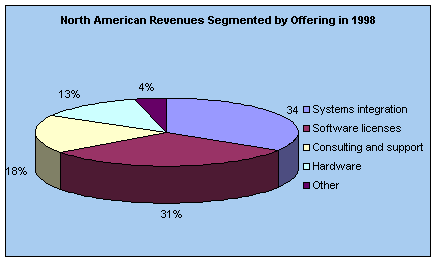
Development Corp. (VDC)’s study in 1998, the WMS industry is being viewed
as a key segment of the larger supply chain execution markets. The
study shows that systems integration generated the most revenue for
WMS suppliers in North America in 1998, followed by software licenses,
consulting and support, and hardware (see the chart below).
Source: Venture Development
Suppliers
expect software license revenues to grow at the fastest rate because
of increased standardization of software packages and interfaces, and
a greater emphasis on the development of integration partner networks.
VDC's study in 1998 anticipates the WMS market to grow about 20% annually
for the next two years, with a 17% fly year cumulative average growth
rate through 2002. [3] Furthermore, the
expected use of the Web as a facilitator of inexpensive real-time access
to salient data on the part of all participants in any given supply
chain is expected to accelerate SCM market growth to $18.6 billion in
2003. In another word, Web-based SCM is another piece of the business-to-business
(B2B) e-Commerce market which, according to the Yankee Group, is expected
to grow at a compound annual rate of 41% over the next three years,
reaching $541 Billion (source: NetApp Press Release).
Fragmented Market Standards
As enterprises
ramp up supply chain collaboration initiatives, standards will lower
the cost of collaboration and enable trust among trading partners.
However, standards for e-commerce and extended trading relationship
are immature, and many are still in development. This hurdle is a stark
reality for enterprises racing to reap the acknowledged benefits of
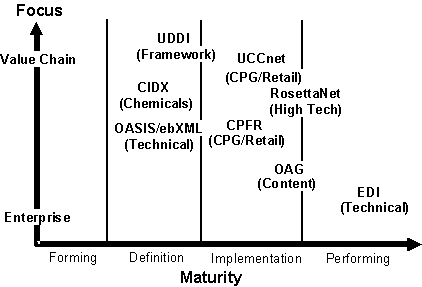
extended supply chain relationships. There are four categories of standards
evolving for collaborative SCM, each at different rates (see exhibit
below): content (e.g., XML.org, BizTalk.org, Open-Applications.org),
framework/registry (e.g. UDDI), technology-based (Ariba, Commerce One,
i2 Technologies and Microsoft), and industry-specific.
Source:
Gartner Research
Standards
development is still in a nascent state, but Gartner Group expects it
to mature rapidly during the next five years, with integration between
various standards occurring after 2005. Enterprises in industries with
existing standards initiatives should become early adopters for competitive
advantage, realizing that incremental rework will be required as they
mature. Enterprises in industries with no standards initiatives should
work with trading partners and competitors to begin standards development
immediately.
Technology Overview
The
Supply Chain Management (SCM) market has been been driven by industry
trends over the past two decades, forcing companies to reduce costs
while at the same time trying to meet increasing customer demands.
During the early years of SCM development, software focused on these
two targets - costs & customers. The latest versions of SCM software
have been focusing on creating an integrated Supply Chain that manages
the whole process, starting with the raw materials all the way through
to the customer.
Internal Processes
Supply
chain management software was initially targeted towards internal process
refinement and coordination. The goal was to regulate the flow of raw
materials, decrease the amount of inventory on-hand, while at the same
time ensuring enough materials were available to manufacture the products
demanded by the market. As a by-product, the bullwhip effect would
also be reduced, reducing costs even further.
Source:
IBM Global Services
Systems
View
By
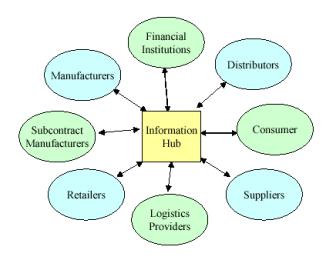
its very nature, an integrated supply chain ties together different
business functions and outside partners with the goal of delivering
the product to the consumer with minimum cost. The supply chain management
software accepts input from all of these sources and coordinates the
flow of raw materials and finished goods. At its core, it functions
as an information hub and triggers actions based on current business
needs. Different software modules are optimized to perform various
functions. For example, Manugistics has separate products to address
facilities locations, freight payment methods, and shipment monitoring
via e-mail, fax, and phone.
Transactions/Standards
At
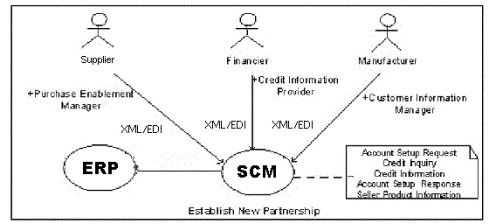
its core, Supply Chain Management software acts as the intermediary
between the Manufacturer and the Supplier. During a typical transaction,
the SCM software will tie into the Enterprise Resource Planning (ERP)
system to update and retrieve data in the Accounts Payable system.
In addition, the SCM software will connect to a third party financial
system to verify a supplier is a good credit risk before the SCM software
completes a sale. All of these communications are built upon EDI standards
that facilitate the data transfer and help to complete the transaction.
The following illustration identifies the logical components of a typical
Supplier/Manufacturer transaction.
Source:
http://www.edifecs.com/downloads/Edifecs_Enablement.pdf?Download=Download
IT
Components
As
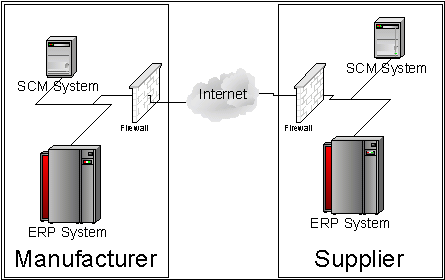
mentioned earlier, the SCM system does not work in isolation. A typical
partner in a Supply Chain will have an ERP system running on a mainframe
or other high-powered server. The ERP system will coordinate activities
for all other systems (SCM, Payroll, Transportation, Warehouse, Planning/Scheduling,
Sales Force Automation, and Customer Relationship Management.) Typically,
the SCM system itself runs on a less powerful system and exchanges information
with the corporate ERP system.
The
company is able to join the partnership by transacting with another
company. In the example below, we are using the Internet as the communications
medium. Prior to the Internet, many companies used private links to
connect to their partners. While private links were more secure, they
limited the number of partners that could reached since the links were
point to point connections. The Internet allows companies to reach
a limitless number of suppliers since it is a many to many network configuration.
SCM
System Comparisons
The
following table compares the SCM software applications provided by some
of the major players in the industry. This set of vendors and applications
is not exhaustive, but provides a sampling across various vendor type
such as best of breed, ERP-oriented, and web-based. Other players in
SCM include: Adexa, Aspen, Baan, FreeMarkets, JD Edwards, Intentia,
Logility, RockySoft, and Synquest.
|
Vendor/App
|
Vendor
Type
|
Market
Position*
|
Key
Capabilities & Features
|
Training
|
|
i2 Technologies
i2
Supply Chain Management
|
Best of Breed
|
Leader
|
·
Creates and manages
a network of customers, suppliers, and partners working together
in real time
·
Includes solutions
for planning, collaboration, service management and supply chain
execution
·
Supports industry
standards such as XML, HTTP, SOAP, RosettaNet
|
Classroom (i2U)
|
|
Manugistics
Supply Chain Management Suite
|
Best of Breed
|
Visionary
|
·
Creates and manages
a network of customers, suppliers, and partners working together
in real time
·
Includes solutions
for network design and optimization, manufacturing planning and
scheduling, sales and operations planning, fulfillment management,
service management
·
Secure trading
networks
|
Classroom (Manugistics University)
|
|
mySAP
SCM
|
ERP Oriented
|
Visionary
|
·
Includes solutions
for networking, planning, coordination, and execution
·
Supports industry
standards such as XML, HTML, and WAP
·
Provides a unified
architecture that can be tailored to specific industries and companies
|
Classroom, E-learning
|
|
PeopleSoft
8 SCM
|
ERP Oriented
|
Niche Player
|
·
Includes end-to-end
solutions for order capture, collaborative planning, fulfillment,
service management, and supply chain analytics
·
Supports real time
web based access
·
Allows for flexibility
and custom solutions
·
Provides a modular
architecture for integrating other PeopleSoft modules
|
Classroom, E-learning (including live webcasts)
|
|
Oracle
Supply Chain Management (E-business Suite)
|
ERP Oriented
|
Visionary
|
·
Includes solutions
for product development, planning, procurement, manufacturing,
and order fulfillment
·
Supports real time
web based access
·
“Intelligent” notifications
based on user-defined tolerances
·
Provides a modular
architecture for integrating other Oracle modules
|
Classroom (Oracle University), E-learning
|
|
Webplan CeO
|
Web Based
|
Visionary
|
·
Customers get real-time
order visibility and instant capable-to-produce information
·
Suppliers have
real-time visibility and instant demand and production and can
simulate the impact of different fulfillment scenarios before
making commitments
·
Enterprise users
can optimize plans and production, track performance across multiple
sites, and collaborate with all stakeholders
·
No infrastructure
required
|
E-learning
|
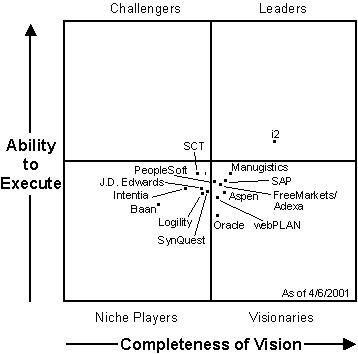
*Note:
The competitive landscape for supply chain vendors as of 2Q01 is depicted
in the figure below, according to Gartner
[4] .
Source:
Gartner Research
The
four quadrants of the marketplace are defined as follows:
• Niche
Players: Focus on a small segment of the market and do it well,
or are unfocused and do not out-innovate or outperform others.
• Challengers: Execute well today and may dominate large segments,
but are not "in synch" with the market's direction.
• Visionaries: Understand where the market is going or have a vision
of changing market rules, but do not yet execute well.
• Leaders:
Execute well today and are positioned well for tomorrow.
A vendor in the Leaders Quadrant must have 10 percent of the overall
SCP license revenue.
Acronym
Key
1) CIDX
The Chemical Industry Data Exchange
2)
CPFR Collaborative Planning, Forecasting and Replenishment
3)
EDI Electronic Data Interchange
4)
ERP Enterprise Resource Planning
5)
HTML Hypertext Markup Language
6)
HTTP Hypertext Transfer Protocol
7) RosettaNet Originally
founded to address requirements within the high-technology electronics
industry, it now involves new initiatives to encompass the entire semiconductor
manufacturing process.
8)
SCM Supply Chain Management
9)
SCP Supply Chain Planning
10) SOAP Simple
Object Access Protocol
11)
UCCnet Nonprofit organization developing a standard for item
synchronization between trading partners
12)
UDDI Uniform Description, Discovery and Integration
13) WAP
Wireless Application Protocol
14) WMS
Warehouse Management Systems
15) XML
Extensible Markup Language
Useful
Websites
1) http://newfirstsearch.oclc.org
2) http://businessbrowser.onesource.com
3) http://www.usc.edu/isd/elecresources/gartner/
4)
http://www.idsystems.com/reader/2001/2001_01/supp0101/supp0101.htm
5)
http://www.netapp.com/news/press/2000/news_rel_20000705.html
6)
http://www.supplychain.ittoolbox.com
7)
http://supplychaintoday.com/
8)
http://www.supplychainsites.com/softwarelinks.asp
9)
http://www.cio.com/research/scm
10)
http://www.i2.com
11)
http://www.manugistics.com
12)
http://www.sap.com
13)
http://www.oracle.com
14)
http://www.peoplesoft.com
15)
http://www.webplan.com
16)
http://techupdate.zdnet.com
Reference
Web Links
|