









Customizability
Definition
Relevant
Theory
Value Chain
Theory (Porter, 1985) is an approach that embodies
the transformation view. The basic logic the transformation
view is that
a firm exploits activities in which it can add more value than competitors,
including outsourcing or exploiting linkages with customers. The purpose
of such exploitation is to create the firm’s competitive advantage.
Webster’s
Definition
Customizability: The ability to build, fit, or alter
according to individual specifications.
Pine et al. (1993) define mass customization as the ability
to provide individually designed products and services to every customer.
They state, “… in mass production, low costs are achieved primarily
thought economies of scale – lower unit costs of a single project or
service through greater output and faster throughput of production process.
In Mass Customization, low costs are achieved primarily through economies
of scope – the application of a single process to produce a greater
variety of products or services more cheaply and quickly” (1993: 43).
Mass customization is intended to provide
superior value to customers by meeting their unique needs for products
and services (Pine 1999).
Mass customization is a business strategy that customizes
goods for each individual customer in large volume. A variety-to-choose
approach (Russell, 1993) suggests that manufacturers produce more categories of different varieties
in the effort to fit the needs of smaller, more specific segments of
buyers. A "prosumer" mass customization approach has
the product designed to be so flexible that consumers can customize
the product themselves (Toffler, 1980). A made-to-order
mass customization occurs when each customer orders a specific
product, and the manufacturer manufactures and delivers it to meet the
customre’s specifications.
From IS Literature
Customizability
is defined by Nidumolu and Knotts (1998) as the
ability of the software development approach to be tailored to the specific
needs of individual projects. This study will adapt measurement scales
from Nidumolu and Knotts.
From
Marketing Literature
Logman (1997) developed a marketing mix chart to capture the
concept of customizability.
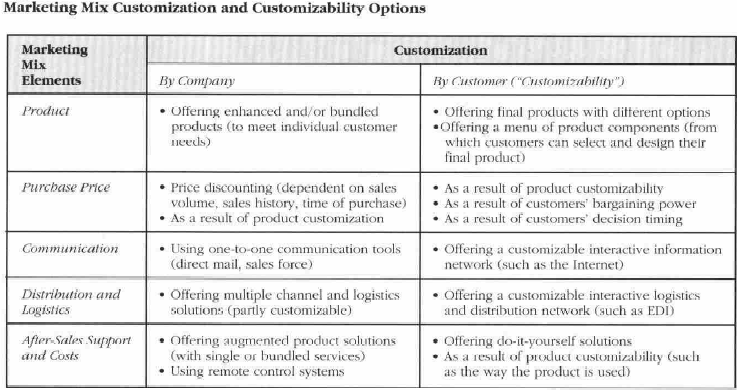

Customizability focuses on the requirements
from multimedia materials so that they are amenable to customization
by third parties, such as end-users with different perspectives and
scopes of use (Roschelle et al.,1999).
Customizability
can come in two forms: Programmer customizability, meaning that experienced
programmers can develop new tools for the system, and end-user customizability,
which means that new components can be added to the running system and
are directly available to users (Begole et al.,1999).
Customizability allows the user interface
to be modified by the user or the system. It can be
categorized as adaptivity and adaptability. Adaptability refers to a
system that is modifiable by the user. Such modification ranges from
the simple act of changing fonts to the more
complex activity of changing contents. Adaptivity refers to a system
that learns the levels or frequencies of interaction of a given user
and alters its appearance or behavior accordingly.