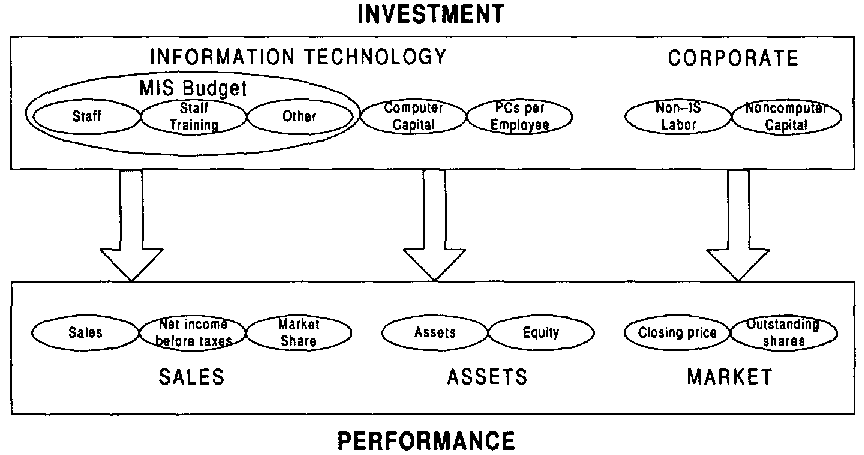




Items
Authors propose a
number of items to use when measuring IS investments.
The following implications for corporate management result from research
findings. It is quite possible that these implications may vary from one
system to another.
- Steady investment in information technology should be considered for enhancing organizational strategic and economic performance.
- 2. To improve organizational performance, IT investment must be accompanied by appropriate employee training.
- 3. When evaluating the impact of IT investment on organizational strategic and economic performance, performance measures such as sales by total assets, market value to book value, return on investment, sales by employee, and return on sales should be considered.
- 4. In view of the questions raised by the present study on the use of growth in revenue as a valid organizational performance measure, further study must be considered in the areas of transactional, informational, and strategic IT investment.
- 5. Measures such as IT budget as a percentage of revenue, percentage of IT budget spent on IT training, number of PCs and terminals as a percentage of total employees, and estimated IT value as a percentage of revenue should be considered for use as measures of IT investment.
6. Percentage of
IT budget spent on staff should not be considered as an IT investment
measure. [2]
The challenge is that IS investment is often coupled with other complementary
investments such as organizational reengineering, restructuring, and redesign.
Therefore, it is difficult to pinpoint the benefits of the improvement
to one single change. It is also quite possible that the nature of some
businesses may be such that they may not be able to obtain as great a
return from IS as other organization might. While there is no universally
accepted approach to measure payoff of IS investments, some of the benefits
of IS can be derived from:
- Financial data
- Hidden costs and benefits (strategic, tactical, operational)
It should be noted
that a strong correlation between two things does not imply a causal relationship.
A proposed framework for assessing the multidimensional impact of investments
on firm performance is shown below [3]: